
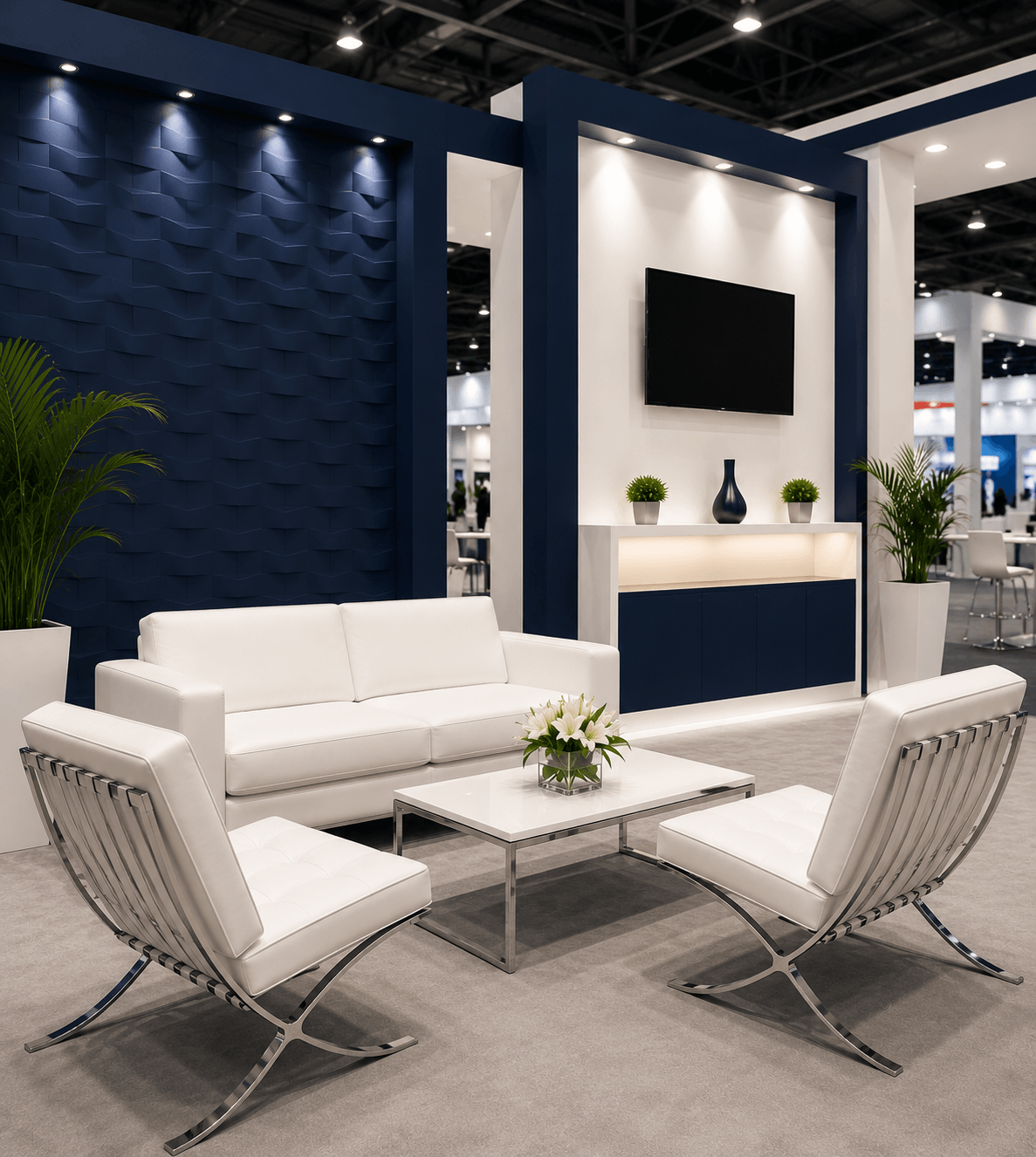
How Much Does a Bespoke Exhibition Stand Cost?
Planning a bespoke exhibition stand usually starts with an exciting idea. You want something that represents your brand properly, attracts attention across a busy exhibition hall and gives your team a great space to meet potential customers.
Then comes the obvious question.
How much does a bespoke exhibition stand actually cost?
There is no single price that applies to every stand. A relatively simple bespoke stand for a smaller exhibition space will cost considerably less than a large island stand with custom structures, LED screens, meeting rooms and specialist lighting.
The important thing is understanding what you’re paying for.
A bespoke exhibition stand isn’t simply a collection of walls and graphics. The price can include design, materials, manufacturing, graphics, flooring, lighting, furniture, transport, installation and dismantling.
In this guide, we’ll explain what determines the cost of a bespoke exhibition stand, where your budget goes and how to get the best value from your investment.
What Is a Bespoke Exhibition Stand?
A bespoke exhibition stand is designed specifically around your business rather than being based entirely on a standard layout.
The design can take into account your brand, products, target audience, exhibition objectives and the exact floor space you’ve booked.
That means you have much greater freedom over elements such as the shape of the stand, wall heights, visitor flow, meeting areas, product displays, storage and technology.
Depending on the project, a bespoke stand might include:
- Custom walls and structures
- Branded graphics
- Feature lighting
- Reception counters
- Product displays
- Integrated screens
- Storage areas
- Private meeting rooms
- Hospitality areas
- Bespoke furniture
- Raised flooring
- Suspended branding
- Interactive displays
You don’t necessarily need all of these features. A good exhibition stand design should only include elements that serve a purpose for your business.
Why Is There No Standard Price for a Bespoke Exhibition Stand?
Two businesses could book exactly the same size exhibition space and end up with completely different stand costs.
One might want an open layout with attractive graphics, a reception counter and a screen.
The other might want a private meeting room, custom product displays, integrated lighting, several large screens and premium finishes.
The floor area is identical, but the amount of design, manufacturing, equipment and labour required is completely different.
This is why exhibition stand builders usually need to understand your brief before providing an accurate quotation.
Your stand size matters, but it is only one part of the calculation.
Stand Size Has a Major Impact on Cost
Unsurprisingly, larger exhibition stands generally cost more.
A larger footprint usually requires more flooring, structural components, graphics, lighting and labour.
However, cost does not necessarily increase at exactly the same rate as floor area.
A simple 6m x 3m exhibition stand could potentially cost less than a highly detailed 3m x 3m stand containing specialist displays and premium materials.
This is why it is better to think about the complexity of the entire design rather than focusing solely on the number of square metres.
The Design Itself Affects the Price
One of the biggest advantages of choosing a bespoke exhibition stand is creative freedom.
It is also one of the factors that can influence the budget most significantly.
Simple designs using clean walls, strong graphics and open layouts can be relatively efficient to manufacture.
More ambitious designs may incorporate curved structures, unusual shapes, large architectural features, illuminated branding or custom joinery.
Every additional feature requires materials, production time and installation.
The aim should never be to make a stand complicated simply for the sake of it.
Sometimes the most effective exhibition stands are surprisingly simple.
Good exhibition stand design is about creating the right environment for conversations, demonstrations and brand recognition rather than filling every available space.
Materials and Finishes
The materials used to build your stand also influence the final price.
A practical modular structure with printed fabric graphics will usually cost less than a heavily customised stand incorporating timber joinery, glass, specialist flooring and premium finishes.
There is no reason every surface needs to be expensive.
An experienced designer can often combine premium features in the areas visitors notice most with more cost effective materials elsewhere.
This allows you to create a high quality appearance without unnecessarily increasing the budget.
Graphics and Branding
Your graphics are one of the most important parts of an exhibition stand.
Visitors walking through a busy exhibition hall need to understand who you are and what you do quickly.
Your graphics might include your company logo, campaign messaging, product photography, service information and large scale brand imagery.
The cost will depend on the amount of printed material required, the type of graphics being produced and how they are integrated into the stand.
Large seamless fabric graphics, illuminated displays and specialist finishes will naturally cost more than straightforward printed panels.
However, graphics are rarely an area where we recommend cutting corners.
A beautifully constructed stand with poor quality graphics can still look disappointing.
Lighting
Lighting can completely change how an exhibition stand feels.
Even relatively simple structures can look premium when they are lit properly.
Your stand might use spotlights, LED strips, illuminated logos, feature lighting or integrated lighting within product displays.
More sophisticated lighting designs will increase the overall cost, but they can also dramatically improve visibility and presentation.
Rather than adding lighting as an afterthought, it should ideally be considered during the initial exhibition stand design.
Screens, AV and Technology
Digital displays are increasingly common on modern exhibition stands.
Screens can be used for product demonstrations, brand videos, presentations, interactive experiences or live demonstrations.
Depending on the stand, you might require one television or an entire LED video wall.
Technology can include:
- Television screens
- LED displays
- Touchscreens
- Tablets
- Interactive displays
- Audio equipment
- Charging points
- Product demonstration equipment
These features can significantly increase the cost of a stand, particularly when specialist installation or additional electrical supplies are required.
The question to ask is whether the technology genuinely improves the visitor experience.
If it does, it may be worth the investment.
Furniture and Meeting Spaces
Furniture is another area that should be considered during budgeting.
A small stand may only require a reception counter and a couple of stools.
A larger bespoke exhibition stand might include several meeting tables, lounge seating, hospitality counters and private meeting rooms.
Think about how your team will actually use the stand.
If your exhibition strategy involves lengthy conversations with potential customers, comfortable meeting areas may be extremely valuable.
If most interactions last only a few minutes, allocating large amounts of space to seating may not make sense.
Storage
Storage is easy to overlook when designing an exhibition stand.
Your team will probably arrive with bags, coats, brochures, promotional items, water and personal belongings.
Without somewhere to put them, a beautiful exhibition stand can quickly become cluttered.
Integrated storage cupboards or a small store room can therefore be worth including.
They will add to the build cost, but they can make the stand considerably more practical throughout the exhibition.
Installation and Dismantling
A bespoke exhibition stand does not arrive at the venue fully assembled.
A professional installation team needs to transport the components into the exhibition hall, construct the stand, install graphics and lighting, complete finishing work and make sure everything is ready before the event opens.
Once the exhibition finishes, the process happens again in reverse.
The complexity of the stand and the amount of labour required will therefore affect the overall cost.
Some venues also have restricted build schedules, which can require larger installation teams to complete the work within a limited period.
When comparing exhibition stand quotations, always check whether installation and dismantling are included.
Transport and Logistics
Your stand needs to reach the venue safely and on time.
Transport costs can depend on the size of the stand, the number of vehicles required, the location of the exhibition and the venue’s access arrangements.
Exhibitions in central London can present very different logistical challenges from events at large purpose built exhibition centres.
This is another reason why working with experienced exhibition stand builders is valuable. They should understand how exhibition venues operate and plan transport accordingly.
Does the Exhibition Venue Affect the Cost?
It can.
Every venue has its own regulations, access arrangements and service charges.
Exhibiting at ExCeL London may involve different logistical requirements from Olympia London, the NEC Birmingham or Manchester Central.
Venue related costs can include electricity, internet connections, rigging, waste services, parking and specialist handling.
These costs may be charged separately by the organiser or venue, so make sure you understand which expenses are included within your exhibition stand quotation.
Modular or Bespoke: Which Costs More?
A modular exhibition stand will generally cost less than a completely bespoke build because much of the underlying structure can be reused.
However, modular does not necessarily mean basic.
Modern modular exhibition stands can incorporate excellent graphics, lighting, screens, storage and high quality finishes.
A bespoke stand becomes particularly valuable when you want something that cannot easily be achieved using a standard framework.
That might include unusual architectural features, large product displays, custom meeting spaces or a completely unique layout.
The right decision should therefore be based on your objectives rather than price alone.
How Can You Reduce the Cost of a Bespoke Exhibition Stand?
Reducing costs does not have to mean making your stand look cheap.
One of the most effective approaches is to decide which elements genuinely matter to your visitors.
For example, you might invest in a strong architectural feature at the front of the stand while simplifying areas that receive less attention.
You can also control costs by keeping the layout open, limiting unnecessary custom joinery, using reusable structural components and focusing your budget on high quality graphics and lighting.
Planning early is equally important.
Last minute changes can result in additional manufacturing, printing and labour costs that could easily have been avoided.
Most importantly, be open about your budget with your exhibition stand designer.
Knowing the available budget allows the designer to create something realistic from the beginning rather than presenting an impressive concept that later has to be stripped back.
Cheap and Good Value Are Not the Same Thing
When comparing exhibition stand quotations, it can be tempting to choose the lowest price.
That does not necessarily represent the best value.
A cheaper quotation may exclude important elements such as transport, graphics, installation or dismantling.
You should also consider the quality of the materials, project management and installation team.
Your exhibition has fixed opening dates. If something goes wrong during installation, there is very little time to solve it.
Reliability therefore has real value.
A good quotation should clearly explain what is included so you can compare suppliers properly.
Think About Return on Investment
The cost of a bespoke exhibition stand should always be considered alongside what you’re trying to achieve from the event.
Imagine one stand costs less but attracts very little attention.
Another costs more but generates substantially more qualified enquiries and creates valuable conversations with potential customers.
The cheapest stand has not necessarily delivered the best value.
Before approving your design, think about how the stand will support your objectives.
Does it make your brand easy to recognise?
Can visitors quickly understand what you offer?
Is there enough space for your team to talk comfortably?
Can products be demonstrated effectively?
Does the stand give people a reason to stop?
These questions are ultimately more important than simply asking how much the stand costs.
What Information Should You Give an Exhibition Stand Builder?
The more information you provide at the beginning, the more accurate your quotation is likely to be.
Ideally, provide:
- The exhibition name
- Venue
- Exhibition dates
- Stand dimensions
- Floor plan
- Your budget
- Brand guidelines
- Products or services being promoted
- Required meeting areas
- Storage requirements
- AV requirements
- Examples of stands you like
You should also explain what you want visitors to do when they reach your stand.
That information helps the designer create something that works commercially as well as visually.
Frequently Asked Questions
How much should I spend on a bespoke exhibition stand?
There is no universal figure because the appropriate budget depends on stand size, design complexity, venue, materials and what you need the stand to achieve. The best approach is to establish your overall exhibition budget first and then allocate an appropriate amount to the stand.
Is a bespoke exhibition stand more expensive than a modular stand?
Usually, yes. Bespoke stands often require more custom manufacturing and installation. Modular exhibition stands reuse structural systems, which can reduce production and labour costs.
Can you hire a bespoke exhibition stand?
Yes. Bespoke design does not necessarily mean you have to purchase and own the stand. Exhibition stand hire can incorporate custom built features and branded elements while allowing reusable components to be returned after the event.
Does exhibition stand hire include graphics?
This depends on the supplier and quotation. Always check whether design, graphics, flooring, furniture, transport, installation and dismantling are included before comparing prices.
How far in advance should I organise a bespoke exhibition stand?
The earlier you start, the better. Bespoke stands require time for briefing, design, revisions, production and logistics. Larger or more complex projects should be planned particularly early.
Can a bespoke exhibition stand be reused?
Yes. Depending on how it is designed, certain structures, graphics and components can potentially be reused or adapted for future exhibitions. If reuse is important, tell your designer at the beginning of the project.
Planning a Bespoke Exhibition Stand?
The cost of a bespoke exhibition stand depends on much more than its size.
Design complexity, materials, graphics, lighting, technology, furniture, transport and installation all influence the final quotation.
Rather than starting with the question, “What’s the cheapest stand we can build?” start with a better question:
What do we need this exhibition stand to achieve?
Once you understand your objectives and budget, an experienced exhibition stand company can design a solution around both.
At Exhibition Stand Hire, we design, build and install exhibition stands for businesses exhibiting across London and the UK. Tell us which exhibition you’re attending, your stand dimensions, your budget and what you’d like to achieve, and we can help you develop the right solution for your event.